Understanding the System Marginal Price (SMP)
Background
Malaysia’s electricity market has changed significantly in recent years with the introduction of several renewable energy programmes. These developments have increased interest in the System Marginal Price (SMP) as a reference point for electricity pricing.
Key developments include:
- 2021 – NEM 3.0 NOVA: Introduced under the Net Energy Metering 3.0 framework. Electricity exported to the grid is credited based on the SMP.
- 2022 – CGPP: The Corporate Green Power Programme allows corporate buyers to procure renewable electricity through virtual power purchase arrangements (VPPA). Under CGPP, SMP applies to settlement between the generation company (GENCO) and Tenaga Nasional Berhad (TNB). GENCOs may also use SMP as a reference when determining their financial arrangements with corporate buyers.
- 2024 – CRESS: The Corporate Renewable Energy Supply Scheme further expands corporate access to renewable electricity through the grid and reinforces the relevance of SMP as a market reference price.
- From 2026 – Solar ATAP: The Solar Accelerated Transition Action Programme has replaced NEM 3.0 and continues the transition towards market-based solar pricing.
In this evolving market environment, SMP is increasingly used to understand underlying electricity costs and price movements. It is particularly relevant for solar developers, corporate electricity buyers, lenders and other stakeholders when assessing renewable energy projects and electricity procurement or funding decisions.
As a result, common questions include:
- What is SMP?
- How is SMP calculated?
- What causes SMP to change?
- What might happen to SMP in the future?
This article addresses these questions by explaining the fundamentals of SMP using simple examples. It is structured as follows:
- What is System Marginal Price (SMP)
- Understanding the Energy Generation Mix and Dispatch Methodology
- Simplified and Illustrative Scenarios
- Summary
- References
What Is System Marginal Price (SMP)?
Under the Single Buyer market framework in Peninsular Malaysia, SMP is the energy price set by the most expensive generator required to meet electricity demand during a specific dispatch interval.
The Guidelines for Single Buyer Market (Peninsular Malaysia) defines SMP as:
“The price of the most expensive marginal generator included in the Draft Day Ahead Dispatch Schedule to meet the Day Ahead Load Forecast in a Half-Hour Period or the Week Ahead Dispatch Schedule to meet the Week Ahead Load Forecast.”
In simple terms, SMP represents the cost of electricity from the last and highest-cost generator (power plant) that must be dispatched to meet demand at a particular time. Even if most electricity is supplied by lower-cost generators, this marginal generator sets the SMP for that dispatch interval.
Understanding the Energy Generation Mix and Dispatch Methodology
To understand how the SMP is determined, it is helpful to first look at Malaysia’s electricity generation mix and dispatch methodology.
(1) Peninsular Malaysia’s Generation Mix
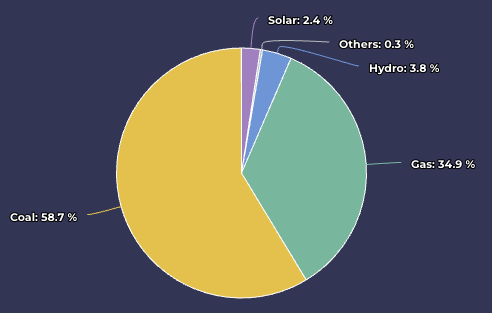
As illustrated in Figure 1, Peninsular Malaysia’s electricity supply is mainly supported by thermal power generation, with coal and natural gas forming the core of the generation mix. Based on data published by the Single Buyer, the average monthly generation mix between October and December 2025 was approximately:
- Coal: 58.7%
- Natural Gas: 34.9%
- Hydropower: 3.8%
- Solar: 2.4%
- Others: 0.3%
(2) Dispatch Methodology: Least Cost Dispatch Scheduling Model
To efficiently manage electricity generation, TNB, through its Single Buyer function, employs a Least Cost Dispatch Scheduling Model.
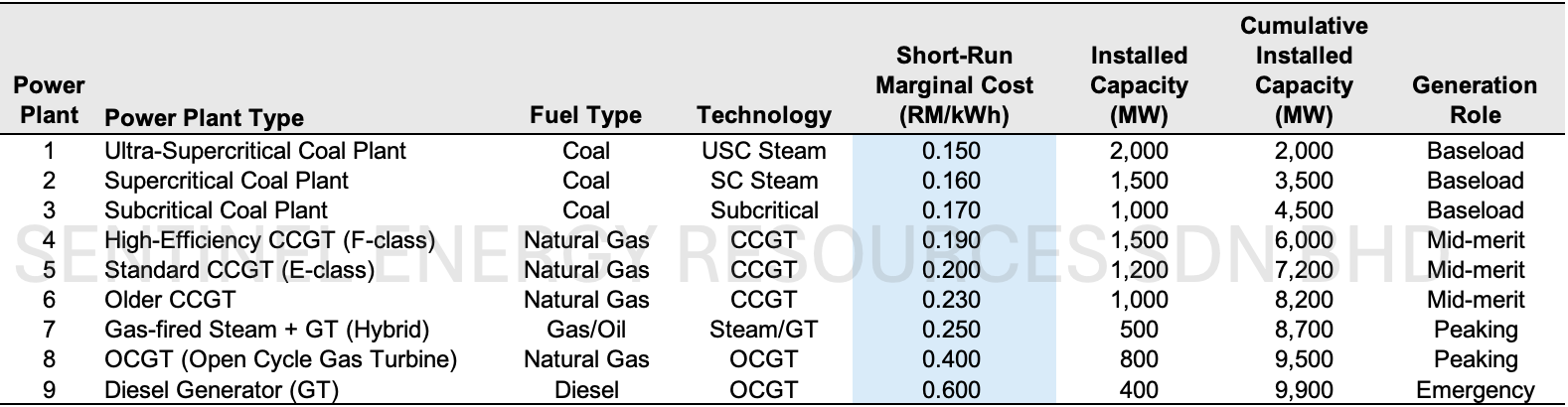
Under this model, available generators (power plants) are ranked in a Merit Order List (MOL) based on their short-run marginal cost (SRMC), which mainly reflects fuel costs and other variable operating expenses. Lower-cost generators (power plants) are dispatched first, while higher-cost plants are only dispatched when additional electricity is needed to meet demand.
Dispatch schedules are prepared on both a day-ahead and week-ahead basis in accordance with the Guidelines for Single Buyer Market (Peninsular Malaysia). Generators (power plants) are dispatched sequentially along the merit order until total system demand is fully met, as illustrated in Figure 2.
Figure 2: Example of Electricity Generation Merit Order Table (Illustrative)
Let’s Look at Some Scenarios
The scenarios below show how SMP changes in response to system demand and power plant availability. The prices shown are illustrative only and expressed in RM/kWh for ease of understanding.
Scenario 1: System Demand at 7,000MW
At a demand level of 7,000 MW, Power Plants 1 to 5 are sufficient to meet system requirements as they provide a combined capacity of 7,200 MW.
Figure 3: Illustrative Merit Order Scenario – System Demand at 7,000MW
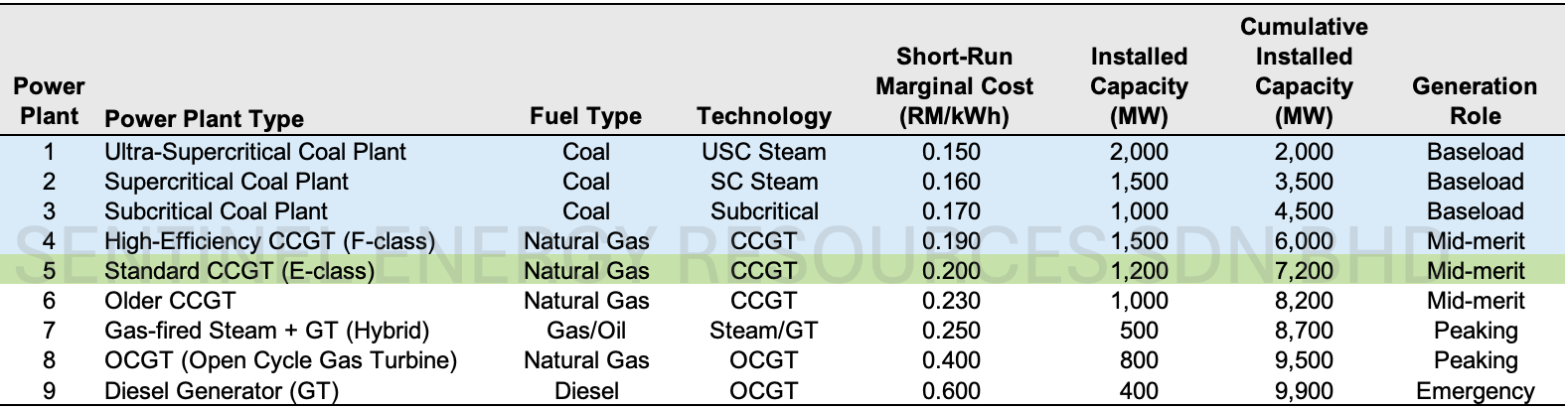
> Result: The most expensive power plant (Power Plant 5) needed to meet demand sets the SMP at RM0.20 per kWh.
Scenario 2: Plant Outage at Same Demand Level (7,000MW)
If Power Plant 3 is unavailable due to scheduled maintenance, the system must dispatch the next available higher-cost power plant (Power Plant 6) to meet the same level of demand.
Figure 4: Illustrative Merit Order Scenario – Plant Outage at 7,000MW Demand
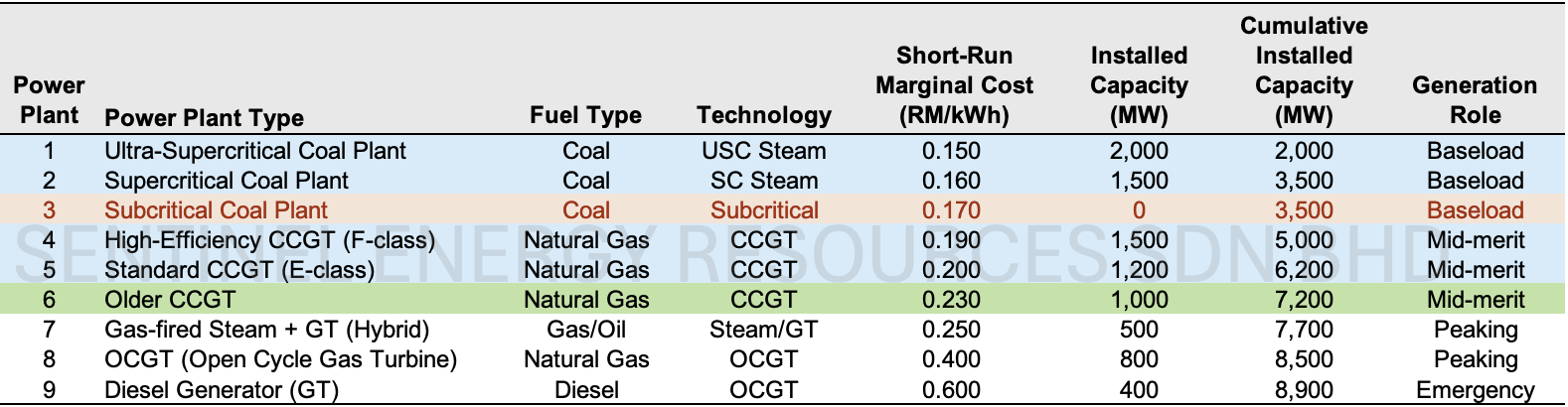
> Result: The SMP increases to RM0.23/kWh due to the higher cost of the replacement power plant (Power Plant 6).
Scenario 3: Demand Increases to 9,000MW
When system demand rises to 9,000 MW, additional higher-cost power plants (Power Plants 6, 7 and 8) are required to meet demand.
Figure 5: Illustrative Merit Order Scenario – Demand Increases to 9,000MW
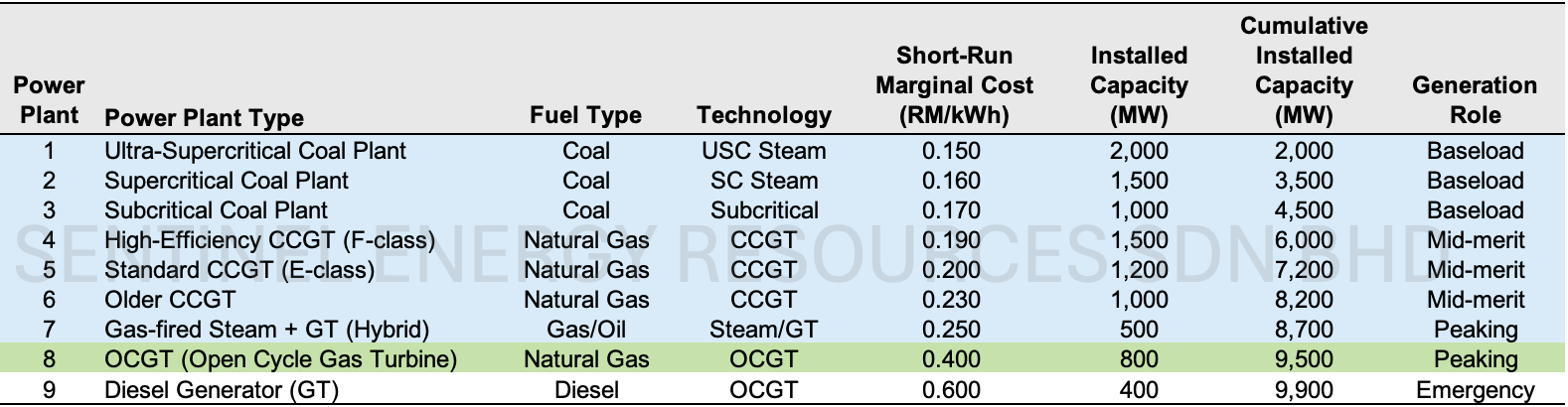
> Result: The SMP rises to RM0.40/kWh, as Power Plant 8 is required to meet demand.
Scenario 4: System Demand at 4,000MW
During periods of low demand, such as a public holiday weekend, only the lowest-cost power plants (Power Plants 1, 2 and 3) are required.
Figure 6: Illustrative Merit Order Scenario – System Demand at 4,000MW
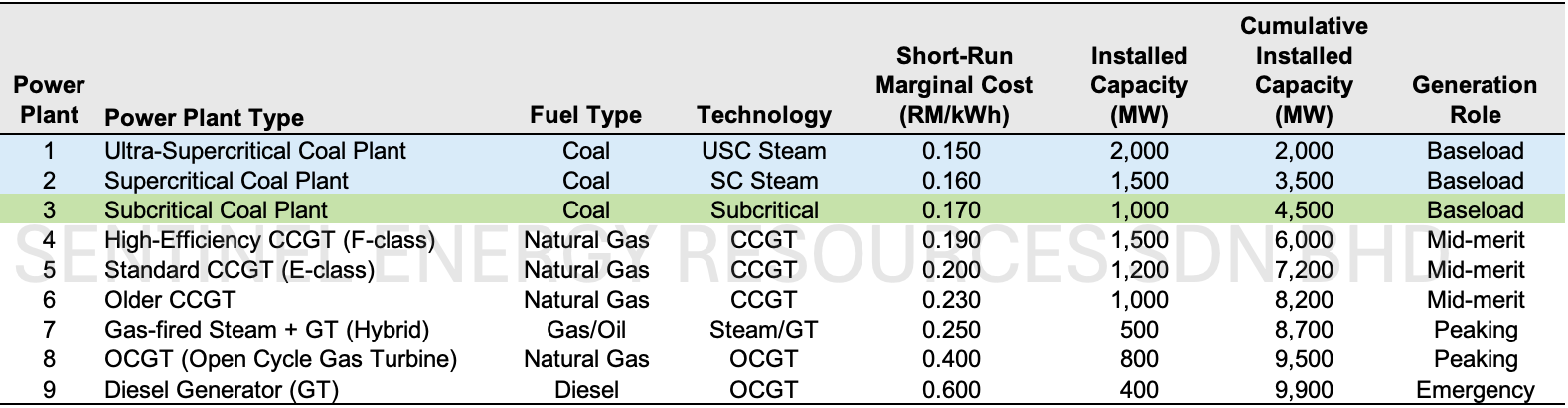
> Result: SMP drops to RM0.17 per kWh (Power Plant 3).
In Summary
The System Marginal Price (SMP) reflects the cost of electricity set by the most expensive power plant required to meet system demand during a particular dispatch interval. Under the least-cost dispatch and merit order framework, power plants are scheduled from the lowest to the highest short-run marginal cost until total demand is met.
The illustrative scenarios show that:
- Moderate demand generally results in relatively stable SMP levels.
- Power plant outages can increase SMP, as higher-cost plants must be dispatched to replace unavailable capacity.
- Higher demand leads to higher SMP when more expensive plants are required.
- Low demand periods typically result in lower SMP, as only lower-cost plants are needed.
While system demand and power plant availability are the main drivers of SMP, other factors, such as fuel prices, plant efficiency, operational constraints and government policy, can also influence SMP outcomes. These factors are beyond the scope of this introductory article.
For historical SMP trend, please refer to this article.
Author’s Note: This article reflects the author’s personal perspective and is written to explain the subject in a practical manner. It is intended to assist non-specialists, including investors, project developers, and general stakeholders, to understand the topic. The content focuses on general concepts and does not constitute regulatory or financial advice.
© 2026 Sentinel Insights. This article is based on professional experience, research, and may be refined using AI tools for clarity. Constructive discussion is welcome; however, hostile or misrepresentative criticism will not be entertained. Referencing is permitted with proper credit. Unauthorised use, reproduction, or redistribution is strictly prohibited and may result in legal action.